 by
by 
Oracle just laid off 30,000 people. Elon says every desk job is dead. But the data says influencer marketing jobs are doing just fine — and here’s why.
Open any news app and the narrative is clear: AI is coming for your job. It’s writing the code, designing the ads, drafting the emails, analyzing the spreadsheets, and — if you believe the loudest voices — making every knowledge worker on the planet obsolete within the decade.
If you work in marketing, the anxiety is even more acute. Your entire function is built on content, data, and communication — exactly the things large language models are supposedly best at. One of the first big AI apps was Jasper… which is literally a copy-writer.
But the reality is not all marketing jobs are equally exposed to AI. In fact, one particular discipline isn’t just surviving the AI revolution — it’s actually growing while everything around it contracts.
That discipline is influencer marketing. And the data backing this up is remarkable.
A few weeks ago I wrote about the agentic future of influencer marketing — a framework for which parts of creator marketing AI agents will run and which parts humans need to own. That post was about how the role is evolving. This one is about why it’s surviving — and what the labor market data says about influencer marketing’s structural resilience while other marketing functions face real displacement.
1. The Doom Narrative (And Why It’s Scarier Than You Think)
Let’s not sugarcoat this. The disruption isn’t coming — it’s here.
By several measures, that was one of the most prolific layoffs of all time. At a company (Oracle) that was spitting out record profits.
Elon Musk has been the most vocal prophet of AI-driven obsolescence. At a 2025 summit, he said that AI would eventually be able to do anything a human can do intellectually, and that the transition would render traditional employment as we know it unrecognizable. He’s doubled down at every opportunity since, predicting that anyone whose job is primarily performed at a computer screen faces replacement.
And as of March 2026, we no longer have to speculate about which jobs he’s talking about. Anthropic just showed us the receipts.
In their Labor Market Impacts of AI report (March 2026), Anthropic introduced a new metric called “observed exposure” — measuring not what AI could theoretically automate, but what it’s actually automating right now in real workplaces. The results are staggering.
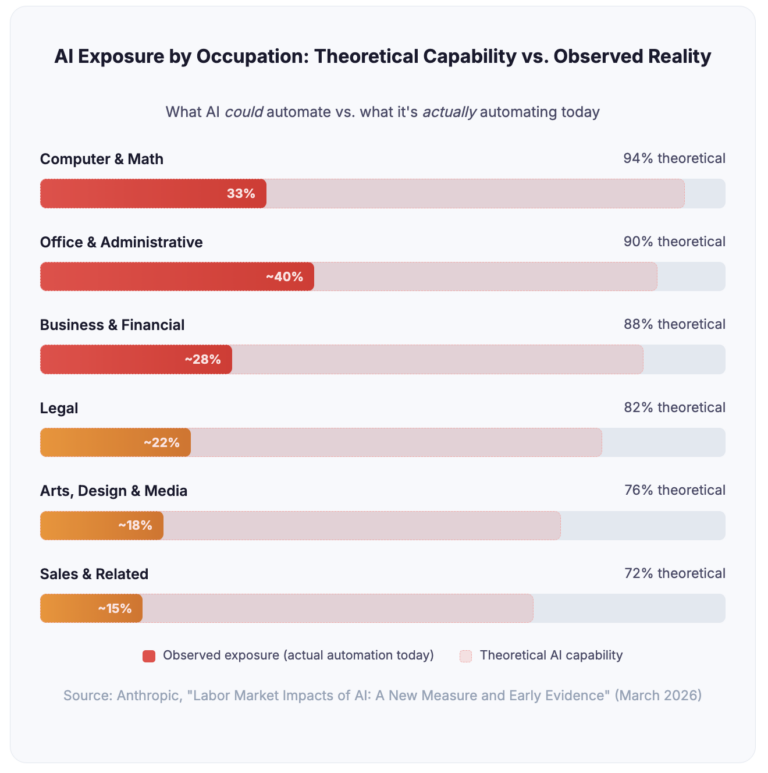
You can debate whether marketing falls under computer, business, office, media, etc. Either way, the anticipated displacement is 70-90%.
That dashed line in the chart above? That’s the ceiling. And every month, the solid bar creeps closer to it.
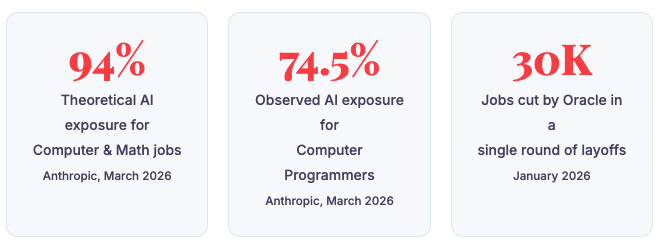
And the older macro research only reinforces the scale. Goldman Sachs estimated 300 million jobs worldwide exposed to AI-driven automation. McKinsey pegged 47% of all work tasks as automatable. The World Economic Forum projected 92 million jobs displaced by 2030.
So here’s the uncomfortable reality: if you work at a computer, AI can theoretically do somewhere between 70% and 94% of your job. The question is just how fast that theoretical ceiling becomes actual displacement.
Which makes it even more remarkable – influencer marketing jobs are actually growing.
2. What 180 Million Job Postings Actually Tell Us
Opinions are everywhere on future job displacement. Data is a bit more scarce and anecdotal. But in my opinion, one study stands out as the clearest measure of the current direction of the labor market.
In late 2025, Bloomberry analyzed nearly 180 million global job postings to determine which specific job titles were actually growing or declining year-over-year. Not vibes. Not predictions. Actual hiring demand, measured by job listings across thousands of companies worldwide.
The overall picture: total job postings declined 8% in 2025 compared to 2024. That’s the baseline — the gravity pulling everything down.
Now look at what happened to specific roles:

Read that chart again. In a market where virtually every category is contracting, Bloomberry flagged influencer marketing as one of the few marketing roles that actually grew — a standout in a sea of decline. The study didn’t publish an exact percentage, but the directional signal is unambiguous: while graphic artists, photographers, and journalists all cratered by double digits, demand for influencer marketers moved in the opposite direction.
Meanwhile, creative execution roles — the ones most directly replaceable by generative AI — cratered. Computer graphic artists dropped 33%. Photographers, journalists, PR specialists: all in significant decline.
But influencer marketers? Hiring more. In a down market. While AI tools proliferate.
3. Why Marketing Is Ground Zero for AI Disruption
Before we get into why influencer marketing is different, it helps to understand why the rest of marketing is so exposed.
Marketing, more than almost any other business function, is built on tasks that generative AI does well: writing copy, producing visuals, analyzing data, scheduling campaigns, personalizing emails, optimizing bids, and testing variants. A significant portion of the marketing workflow is what you might call execution-layer work — turning a strategy into outputs.
AI is exceptionally good at execution-layer work. That’s why 85% of marketing professionals already use AI tools for content creation, according to industry surveys. It’s why content marketing and SEO — disciplines built heavily on volume, keyword targeting, and format production — are seeing the most visible disruption.
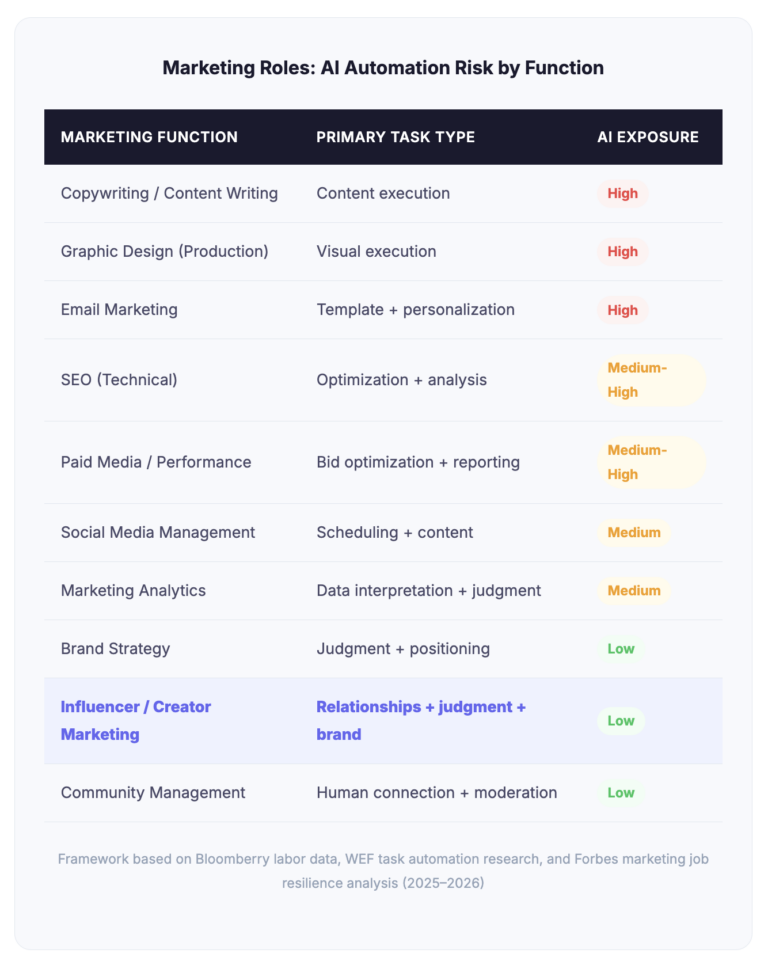
The pattern is clear. The more a marketing role depends on producing outputs — words, images, data summaries, optimized bids — the more exposed it is. The more it depends on human judgment, relationships, and taste — the more protected it is.
Influencer marketing sits firmly in the protected category. And here’s why.
4. The Influencer Marketing Exception
Rand Fishkin, founder of SparkToro and one of the sharpest minds in marketing, put it bluntly when reflecting on the Bloomberry data:
“Digital marketing jobs have been in a tough spot for a couple years now, with SEO, content, and social media roles all declining. But influencer marketing has remained one of the few areas of consistent demand.”
— Rand Fishkin, Founder of SparkToro
Mark Schaefer, marketing strategist and author, offered the deeper explanation:
“Trust in businesses and advertising continues to erode, but we trust each other — our friends and families, and the creators we follow.”
— Mark Schaefer, Executive Director, Schaefer Marketing Solutions
This gets at the structural reason influencer marketing is different. It’s not just another marketing channel. It’s a trust channel — and trust is the one thing AI can’t manufacture.
The numbers reinforce the point. The creator economy has grown to an estimated $32.5 billion as of 2025, with no signs of slowing. As every other digital channel gets noisier and more automated, brands are doubling down on the one signal that still cuts through: real humans, with real audiences, making real recommendations.
5. Four Reasons Influencer Marketing Is Structurally AI-Resistant
The resilience of influencer marketing isn’t a fluke. It’s structural. Here are the four moats that protect this discipline from AI displacement.
Reason 1: It’s a relationship business, not a content factory
The core job of an influencer marketer isn’t to produce content. It’s to identify the right creators, build genuine relationships with them, negotiate terms, manage expectations, resolve conflicts, and maintain long-term partnerships that deliver results over time.
This is fundamentally different from writing a blog post or designing a banner ad. Those are production tasks — and production tasks are exactly what AI automates. But managing a portfolio of human relationships? That requires empathy, cultural fluency, diplomacy, and the ability to read between the lines of a DM. AI can draft the outreach email, but it can’t build the trust that makes a creator say yes to a long-term ambassadorship.
The Bloomberry study found this exact pattern across every function: execution roles are declining, while roles that involve complex decision-making and relationship management are holding steady or growing. Creative directors outperformed graphic designers. Account managers outperformed account executives. And influencer marketers outperformed virtually every other marketing specialization.
Reason 2: Brand judgment can’t be automated
Which creator is right for a luxury skincare line versus a DTC protein brand? Which micro-influencer has an audience that actually converts versus one that just scrolls? When should a brand walk away from a creator whose personal brand is shifting in a direction that doesn’t align?
These are judgment calls that require deep understanding of brand positioning, audience psychology, cultural context, and market dynamics. AI can surface data to inform these decisions — follower counts, engagement rates, audience demographics — but the actual decision requires a kind of pattern recognition and taste that remains distinctly human.
This is consistent with what the World Economic Forum has found in its broader workforce research: roles that require complex judgment in ambiguous, high-stakes environments are among the least automatable, regardless of industry.
It’s called a “Brand” for a reason. Human judgement still outperforms AI slop.
Reason 3: The trust premium is rising, not falling
Here’s the irony of AI-generated content flooding every channel: the more synthetic content there is, the more valuable authentic human content becomes.
As consumers become more aware that the blog post they’re reading, the product review they’re scanning, and the social ad they’re seeing might all be AI-generated, the premium on genuine human endorsement goes up. A real creator, with a real face, sharing a real experience with a product — that signal becomes more differentiated, not less, in a world of AI slop.
This is exactly Schaefer’s point about eroding trust in advertising. Traditional marketing channels are getting noisier and less trusted. Creator recommendations are moving in the opposite direction. Brands aren’t hiring more influencer marketers despite AI — they’re hiring more influencer marketers because of AI.
Reason 4: AI agents are making the role more valuable, not less
Far from replacing influencer marketers, AI is actually raising the ceiling on what a great influencer marketer can do — by taking the operational grind off their plate so they can focus on the strategic and creative work that actually differentiates programs.
This is the key insight behind what some are calling the agentic future of influencer marketing: AI agents can now handle creator discovery and vetting at scale, automate outreach personalization, track and tag content as it goes live, manage syndication pipelines across ecommerce surfaces, and compile performance reports — all the data-intensive, multi-step operational work that currently eats up the majority of a creator marketer’s week.
But the work that determines whether a program is mediocre or exceptional — campaign creative strategy, casting and creative direction, high-value content curation — requires human taste, cultural intuition, and brand judgment that agents can’t replicate.
The result isn’t fewer influencer marketing jobs. It’s a transformation of what those jobs look like. Modern creator marketing programs now involve affiliate attribution, revenue tracking, content syndication across ecommerce surfaces, creator storefront management, and performance optimization — a far cry from the “send product to someone with followers” playbook of five years ago.
Platforms like LoudCrowd are building this agentic infrastructure: AI-powered discovery, intelligent content syndication, and performance-driven creator programs at scale — turning creator influence into measurable revenue rather than just awareness.
The pattern here mirrors what the Bloomberry study found across every function: AI tools made software engineers more productive (not redundant), and AI creator marketing tools are doing the same for influencer marketers. The roles are becoming more strategic, more technical, and more connected to business outcomes — which is exactly the profile of jobs that AI strengthens rather than replaces.
6. A Framework: Which Marketing Jobs Are Safe?
The Bloomberry data, combined with broader research from Goldman Sachs, McKinsey, and the WEF, reveals a consistent framework for understanding which marketing jobs are protected and which are exposed.
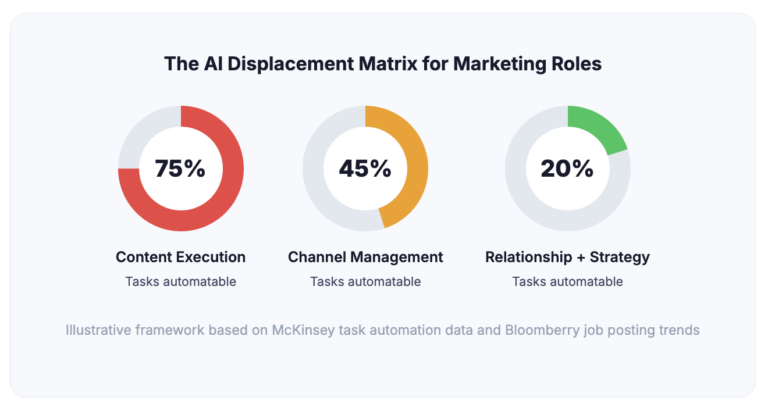
The pattern holds across the board. The Bloomberry study found that individual contributor roles declined 9%, manager roles declined 5.7%, but senior leadership roles declined only 1.7%. The common thread: the higher the ratio of judgment-to-execution in a role, the more resilient it is.
For marketing specifically, the hierarchy of resilience looks like this:

This doesn’t mean exposed roles will disappear overnight. Klarna famously laid off 700 customer service reps to replace them with AI chatbots — and then quietly hired them back when the bots couldn’t handle complex cases. The timeline for displacement is slower than the headlines suggest. But the direction is clear.
7. What This Means for Your Career
If you’re working in influencer or creator marketing, you should feel confident that you cannot be replaced. Your discipline is growing while most of marketing is contracting. The skills that define your work — relationship management, brand judgment, cultural fluency, program strategy — are exactly the skills AI struggles to replicate.
If anything – you are becoming more valuable with AI leverage.
But “AI-resistant” doesn’t mean “AI-ignorant.” The influencer marketers who will thrive are the ones who embrace the agentic shift — letting AI agents handle the operational execution (discovery, outreach, content tracking, reporting) so they can pour their energy into the creative strategy, casting decisions, and relationship management that actually make programs exceptional.
If you’re working in a more exposed marketing function, the move isn’t to panic — it’s to migrate your skills toward the judgment-and-relationship end of the spectrum. The Bloomberry data shows that creative execution roles are declining while creative strategy roles are holding steady. The same bifurcation is playing out across every marketing function.
And if you’re a brand leader deciding where to invest your marketing team’s headcount? The data makes a strong case that creator marketing programs are one of the highest-return investments you can make — not just for performance, but for building a team with structurally durable skills.
The Bottom Line
The AI labor revolution is real. The disruption is real. The 300 million jobs exposed, the 30,000 Oracle employees, the cratering demand for graphic artists and production copywriters — it’s all real.
But the narrative that every knowledge worker is equally at risk is wrong. The data shows a clear bifurcation: roles built on execution are shrinking, and roles built on judgment, relationships, and trust are holding or growing.
Influencer marketing sits squarely on the right side of that divide. It’s a discipline built on human trust, cultural taste, and relationship management — the exact capabilities that AI doesn’t replicate. And in a world where AI-generated content is making every other channel noisier and less trusted, the premium on authentic creator relationships is going up, not down.
The future of creator marketing isn’t less human. It’s more human in the places where humanity matters — and more automated everywhere else. The influencer marketers who lean into that split, who let agents handle the operational grind while they focus on the creative and strategic work that actually differentiates programs, won’t just survive the AI revolution. They’ll be the ones leading it.
Everyone’s looking at AI and asking: who’s next?
The influencer marketers are the ones who don’t have to.
About LoudCrowd
LoudCrowd is building the agentic future of influencer marketing — from AI-powered discovery and recruiting, to performance marketing programs, to ShopWith, our AI Creator Shopping Assistant that brings creator content directly to product pages. If you’re ready to turn creators into a performance channel and creator content into a conversion asset, learn more at loudcrowd.com.
Sources: Anthropic, “Labor Market Impacts of AI: A New Measure and Early Evidence” (March 2026) · Bloomberry, “I analyzed 180M jobs to see what jobs AI is actually replacing today” (Nov. 2025, updated March 2026) · Goldman Sachs, “The Potentially Large Effects of Artificial Intelligence on Economic Growth” (2023) · McKinsey Global Institute, workforce automation research · World Economic Forum, “Future of Jobs Report” · Forbes, “5 Marketing Jobs AI Won’t Replace” (Sep. 2025) · Oracle layoff reporting (Jan. 2026)