Best Social Commerce Platforms in 2026: The 3 Categories
The three kinds of social commerce platform: social-native, third-party creator apps, and on-site. What each is best at, and how to pick, with real numbers.
Most social commerce roundups list twenty tools and rank them by feature count. That doesn’t help when you have one budget and one quarter to prove something works.
Here’s the useful cut. Social commerce is the buying and selling of goods and services through creators and user-generated content, and there are only three places that transaction can happen: on the social platform, on a third-party creator shopping app, or on your own site. Each one produces a different kind of customer, at a different average order value, with a different amount of data left in your hands.
Pashion Footwear ran creator shopping through LTK and Impact.com before moving it onto their own site. Their creator-affiliate conversion rate lifted 680%, and their customer acquisition cost got 22.6% cheaper.
So the platform question isn’t “which tool has the most features.” It’s “where do I want the transaction to happen, and what am I willing to give up for it.”
The three categories at a glance
| Category | Where checkout happens | Best at | What it costs you |
|---|---|---|---|
| Social-native | Inside TikTok, Instagram, YouTube, Pinterest | Impulse volume, fastest checkout, $15–35 AOV | Lowest AOV and LTV, almost no brand exposure, minimal first-party data |
| Third-party creator apps | On LTK, ShopMy, or Flagship | Creator experience, curated discovery, low lift to launch | You rent the customer, one extra click, little brand equity |
| On-site (eCommerce-native) | On your own product pages | Highest AOV and LTV, first-party data, works with every traffic source | One extra click vs. native checkout, needs real setup |
Note the older definition still floating around. Sprout, Hootsuite, and Salesforce all define social commerce as buying and selling directly within a social media platform. That was accurate in 2021. It now describes one of the three categories and misses the two that grew fastest.
1. Social-native platforms
The biggest category by raw transaction volume, and the one most brands try first. TikTok Shop, Instagram Shopping, YouTube Shopping, and Pinterest all let a shopper go from a video or a post to a completed order without leaving the app.
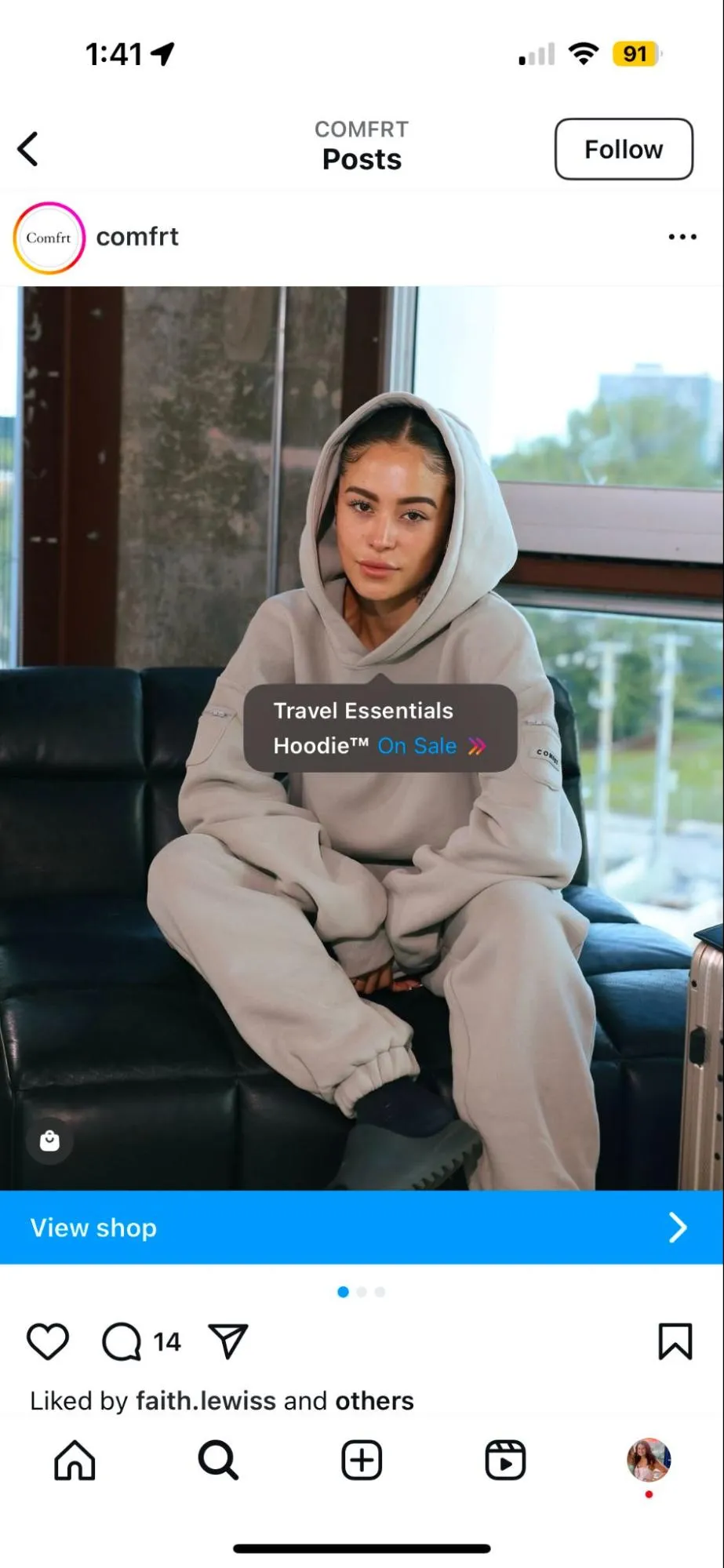
More than 2 billion people use Instagram every month, skewed heavily toward Gen Z and millennials. Instagram Shopping lets a shopper buy the products in a post by tapping the shop icon, then keep browsing the rest of your catalog in the same session. Tagged posts, Reels, and creator collabs all feed the same surface.
TikTok
TikTok Shop turns short-form video and livestreams into direct sales. A shopper taps the shopping icon on a video, or the “Shop” button on a creator’s profile, and checks out in-app. It’s the fastest path from discovery to purchase anywhere in social commerce, which is exactly why it rewards low-consideration products and punishes anything that needs explaining.
YouTube
YouTube Shopping tags products inside videos and livestreams so viewers see pricing and availability while they keep watching. Long-form is the differentiator here: a 12-minute review does work that a 15-second clip can’t, so YouTube converts better on higher-consideration categories.
Pinterest is a discovery surface first. Shoppable pins let a shopper buy the product in the pin without leaving Pinterest, and the intent is unusually high because people arrive already planning a purchase.
What social-native is good at
Speed. Nothing else gets a shopper from “I want that” to “I bought it” in fewer taps. If your AOV sits between $15 and $35 and your product sells itself in a few seconds of video, this is where you’ll see the fastest results. Lower-priced beauty and apparel brands do very well here.
What it costs you
The shopper never meets your brand. They meet a video, then a checkout sheet. You capture minimal data, you can’t route them into a loyalty flow easily, and repeat purchase is somebody else’s problem to solve. Expect your lowest AOV and lowest customer LTV in this channel, and potentially your highest unit volume.
2. Third-party creator shopping apps
The first of the two channels that broke the old definition. These are standalone apps where creators build product curations across many brands, and the transaction happens on the third party’s surface, not yours and not the social platform’s.

LTK
LTK is a social shopping app built around “shop the look.” Creators post shoppable content, and their audience buys the featured products inside the LTK app. It has the deepest creator adoption of the three, particularly in fashion and home.
ShopMy
ShopMy gives creators personalized storefronts stocked with their favorite products from many brands. Shoppers browse a creator’s curation and buy across brands in one place, which makes it strong for discovery-driven categories.
Flagship
Flagship hands creators full control of their storefront branding, so the page reads like the creator’s own shop rather than a template. Same model, more design latitude.
What third-party apps are good at
The software is genuinely better than the social platforms’ own shopping tools. These are focused companies building one experience well, and both creators and shoppers like using them. Setup is light, and if your creators already live on LTK you can be live in days.
What they cost you
Two things. The checkout is a click longer than a native app purchase, so you lose some impulse conversion. And you’re renting the customer relationship: the shopper’s account, purchase history, and next-visit intent belong to the app. Brand equity stays low for the same reason it does on social-native. This is a solid channel. It’s a bad place to put the whole program.
3. On-site (eCommerce-native) social commerce
The newest category and the one that changes the economics. Instead of exporting your creators’ content to somebody else’s checkout, you bring creator-led shopping onto your own product pages: shoppable UGC, creator storefronts hosted on your domain, video and reviews on the PDP.
LoudCrowd
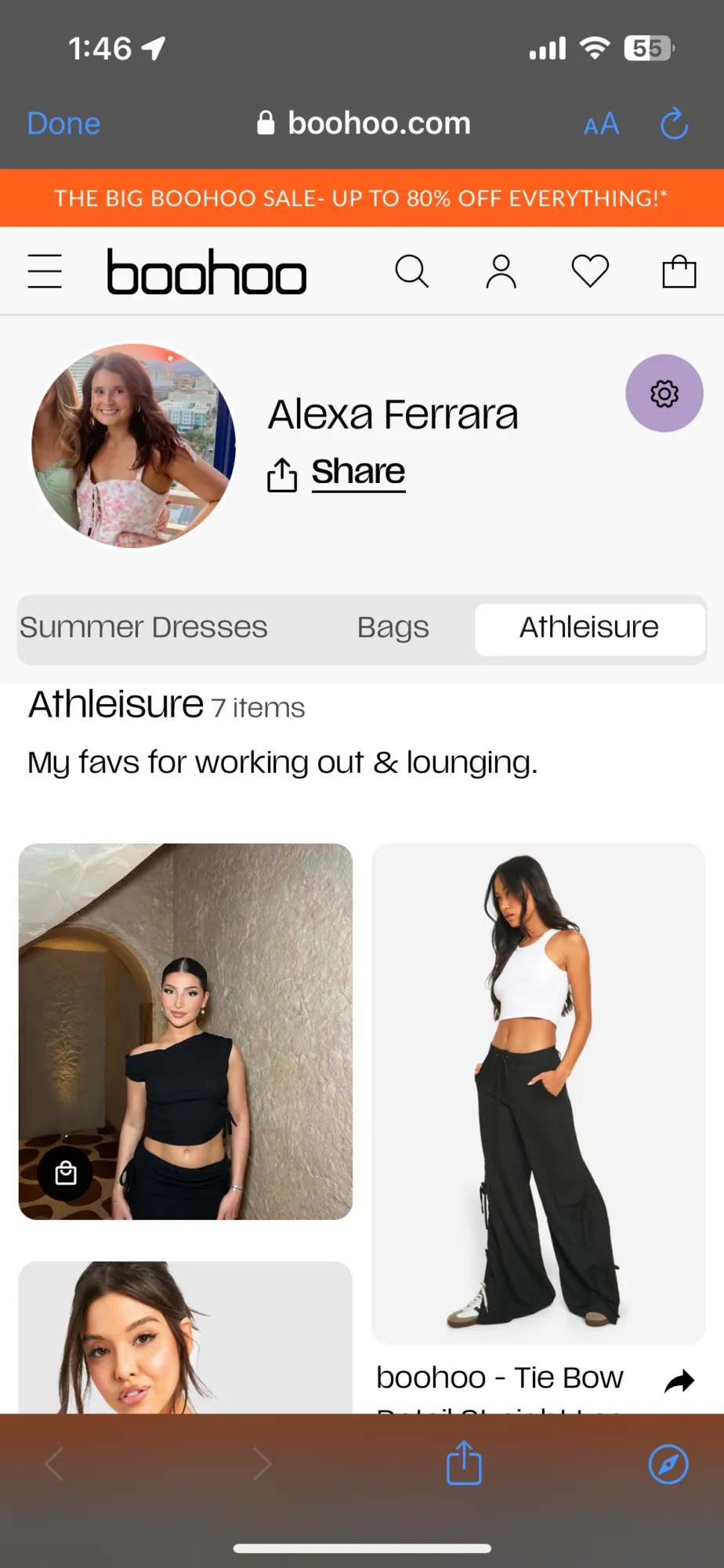
LoudCrowd turns your customers and influencers into creator-affiliates with personalized storefronts hosted on your own eCommerce site. Creators curate collections and tag the products in their social content, which sends traffic and revenue back to your domain instead of a third party’s. ShopWith puts the same creator video, reviews, and AI guidance directly on the product page, and rides on top of the affiliate network you already run — Impact, Rakuten, CJ, Awin, or Partnerize.
boohoo runs thousands of creator storefronts this way. Their program went from paying creators for content to a £15M revenue run-rate at 9X ROI and a £6.1 cost per acquisition.
Tolstoy
Tolstoy builds interactive, shoppable video experiences that live on your site. Shoppers engage with video, ask questions, and buy without leaving your domain. Strong fit if video merchandising is the primary job.
Bazaarvoice
Bazaarvoice puts customer reviews, ratings, and photos across your product pages and social channels. It’s the ratings-and-reviews end of UGC rather than creator commerce, and it’s the most established option in the category.
What on-site is good at
The numbers. Because the whole journey happens on your site, you keep the data, the retargeting, and the loyalty flow, and the customer actually forms a relationship with your brand.
Melinda Maria’s creator storefronts convert 4.5X better than the rest of their site at a 29.8% higher average order value, on $1.5M in annual attributed creator sales. Freedom Rave Wear saw conversion rate climb 33%, AOV climb 23%, and cost of acquisition drop 83% after moving creator shopping on-site.
On-site also compounds with every other channel instead of competing with it. Organic and paid traffic land on pages that now have creator proof on them, social referral traffic gets a continuous experience instead of a context switch, and paid social can point at a page that converts better than a generic PDP.

What it costs you
One extra click compared to buying inside TikTok, and real implementation work: you’re changing your site, not signing up for an app. For impulse purchases at a $20 AOV, native checkout still wins on raw conversion.
How to pick
Run all three eventually. Most brands should. But one of them has to own the program, and that choice follows your economics, not the platform hype cycle.
- AOV under $35, low-consideration product, no repeat-purchase motion. Start social-native. TikTok Shop first.
- Repeat purchase or subscription business, AOV above $50, LTV is the number your CFO watches. Start on-site. Everything else is a feeder.
- Your creators already have LTK or ShopMy followings and you need proof of concept this month. Use third-party as a channel, then move the program on-site once it’s working.
- Premium brand where the shopping experience is the brand. On-site, and don’t dilute it.
Let’s be honest about the trade-off nobody markets: the faster the checkout, the less you own. Social-native buys you volume and costs you the customer. On-site costs you a click and buys you the relationship.
What to ask any social commerce vendor
Feature lists all look the same. These five questions separate them.
- Where does attribution live? If the platform can’t tie a creator to revenue in your own analytics, you’ll be arguing about credit for the rest of the contract.
- Who owns the customer data? First-party email, purchase history, and consent, or a monthly report from someone else’s dashboard.
- Does it work on top of my existing affiliate network? Ripping out Impact or Rakuten to try creator commerce is a bad trade. It shouldn’t be necessary.
- How does it handle discount code leakage? Creator codes end up on coupon aggregators, and leaked codes quietly eat the program’s margin. Ask what blocks it, not whether they’ve heard of it.
- How long until it’s live? Weeks of integration work before the first creator posts means the pilot dies before it produces a number.
Frequently asked
What is the best social commerce platform?
It depends on where you want the transaction. TikTok Shop leads social-native on volume, LTK leads third-party creator apps on creator adoption, and on-site platforms like LoudCrowd produce the highest AOV and LTV because the purchase happens on your domain. If you only get to pick one and you care about repeat purchase, pick on-site.
Is social commerce only TikTok and Instagram?
No, and treating it that way is the most common planning mistake we see. Third-party creator apps and on-site creator commerce are both real channels with real volume, and they produce better AOV and retention than in-app checkout does.
Can I run more than one at once?
Yes, and most brands with a working creator program do. The order that tends to work: prove demand wherever it’s cheapest to test, then move the program to whichever channel gives you the customer relationship, and keep the others as feeders.
Turn creators into your top revenue channel.
Agents, storefronts, and performance programs in one platform — in production for the world's most forward DTC brands.
More from the blog.
All posts → Product
Top White Label Coupon Platform Solutions for Businesses
The best white-label coupon platforms for customer engagement and sales. Compare key features, customization, and tools like Knox AI for your program.
Read more → Product
What Are Influencer Storefronts? The Complete Guide
Influencer storefronts let brands like boohoo and Crocs turn creators into shoppable destinations. The complete guide to how they work and why they win.
Read more → Product
What Makes an Influencer Storefront High-Converting?
"Shop my favorites in my storefront" is everywhere now. What actually makes an influencer storefront convert, with real brand examples.
Read more →