Instagram Finally Allows Product Links: Winners, Losers & Next Steps
Instagram just let creators put affiliate links directly in their content. Here's who benefits, who doesn't, and what you should do next.
Instagram just gave creators the ability to put affiliate links directly in their content. Here’s who benefits, who doesn’t, and what you should do about it.
Instagram affiliate links are a few weeks old now. The dust has settled on Instagram’s rollout of in-content affiliate tagging for creators. And I think we can all be pretty clear-eyed now about what this change actually means for creators, brands, and the platforms that serve them.
I’m going to try to be neutral here. I think this change is very good for LoudCrowd, but this isn’t about talking our own book. This is a straightforward take on the winners and losers of Instagram affiliate links in content — and what you should do about it depending on where you sit.
Let’s jump in.
1. The Biggest Winner from Instagram Affiliate Links: Creators
Far and away, the biggest winners here are creators.
Previously, creators who wanted to include a performance component in their content were shoehorned into some genuinely awkward workflows. Flipping a link-in-bio in and out depending on whatever your latest Story or Reel is? That never made sense. Constantly sharing referral codes and hoping your audience remembers to type them in at checkout? Not great. The workarounds worked, but barely — and they introduced friction at exactly the moment when a consumer was most interested in buying.
Instagram affiliate links fix this in the most fundamental way possible. A creator can now include a direct, trackable link to a product inside the piece of content that’s actually driving the interest. The viewer watches a Reel, gets interested, taps, and lands on the product. One motion. No detours.

That’s a dramatically better experience for the creator’s audience, too. And when you reduce friction for consumers, conversions go up. Creators who were already good at driving sales are about to get better data proving it — which means better deals, better commission structures, and stronger long-term brand relationships.
Here’s the difference, visually:
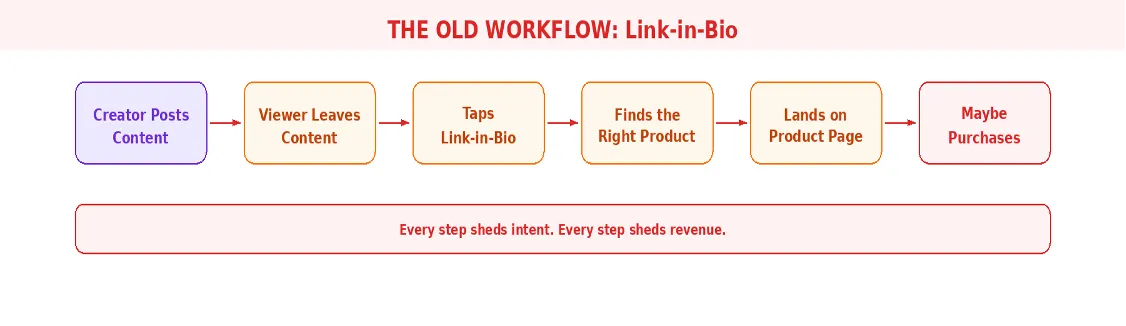
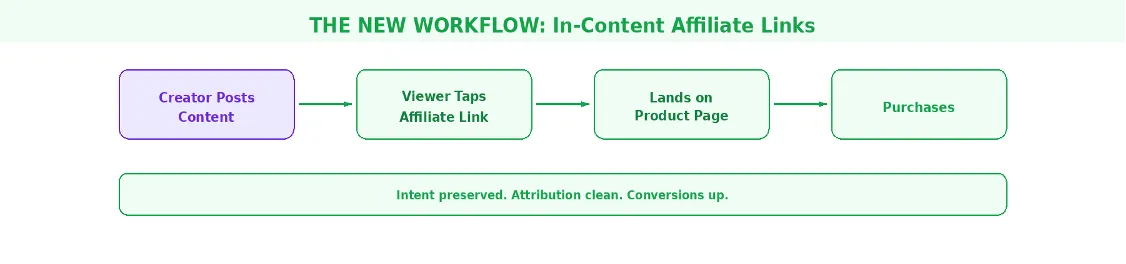
That’s the difference between four or five steps of friction and one tap. This is the biggest unlock for creator monetization since Instagram introduced link stickers in Stories. And it’s not close.
2. Winner: Brands
Brands are also big winners here, and the reason goes beyond just more sales.
The real unlock is clarity. Brands are now going to see with much more precision which creators who provide brand value are also great at performance marketing. That distinction has always been hard to measure. A creator could generate incredible engagement on a Reel, but if the purchase path ran through a link-in-bio or a manually-entered promo code, the attribution was lossy and slow. Brands were making investment decisions based on incomplete data.
With direct, trackable links embedded in the content itself, the signal gets dramatically cleaner. Which creators drive awareness? Which ones actually drive revenue? Which ones do both? Now you can see it. And that changes how smart brands build their creator programs — who gets a deeper ambassador relationship, who earns a higher commission tier, and who gets the next product drop.
The workflow improvement matters too. When a creator gets someone interested in a product, there’s now a much shorter, much cleaner path from that moment of interest to a conversion. Fewer steps. Fewer drop-offs. More revenue. And more revenue with cleaner attribution means brands can finally justify scaling their creator programs with confidence that the numbers are real.
3. Loser from Instagram Affiliate Links: Link-in-Bio Companies
The most direct losers — and I say this with some humility, because I genuinely don’t think these companies care very much — are the link-in-bio platforms. The big three: ShopMy, LTK, and Linktree.
Here’s why. If you’ve spent time inside this industry, you know there are really two types of creator-driven traffic. There’s bottom-of-funnel traffic: someone watches a specific piece of content, gets genuinely interested in that specific product, and is ready to buy. And then there’s top-of-funnel traffic: someone stumbles onto a creator’s page, clicks the link-in-bio, and browses.
Bottom-of-funnel traffic converts at a much higher rate. That’s not controversial — it’s just how purchase intent works.
Previously, both types of traffic got funneled through the same link-in-bio. A viewer who was motivated by a specific Reel still had to leave the content, navigate to the profile, tap the link, find the right product in a menu, and then complete the purchase. All of that friction was diluting bottom-of-funnel intent. In-content affiliate links give that high-intent traffic a direct path. The link-in-bio loses its monopoly on the most valuable click in the creator ecosystem.
But here’s the thing: this isn’t as doomer as it sounds.
ShopMy, LTK, and Linktree are smart companies with enormous creator networks. They will adjust. And more importantly, they’re almost certainly working on products that are far more focused on the future — agentic shopping, AI-driven product discovery, creator-powered commerce surfaces that go well beyond a link aggregator page. The link-in-bio was their wedge into the industry. At this point, they’re not overly dependent on that single workflow.
So: losers on this specific change. But I wouldn’t count them out.
4. Loser: Platforms that only do Influencer or Affiliate Marketing
This is the more interesting loser category. And it’s not one company — it’s a structural problem across the industry.
For years, we’ve talked about the gap between influencer marketing and affiliate marketing. Influencer teams sit over here measuring reach, engagement, and brand lift. Affiliate teams sit over there measuring clicks, conversions, and revenue. Everyone has known these two worlds need to come together. It’s been happening — but more slowly than any of us anticipated.
Instagram’s change is a significant nudge toward that convergence. It’s now dramatically easier for creators to demonstrate performance value alongside their content. The line between “influencer” and “affiliate” just got lighter.
Which means the platforms that try to do one or the other are going to struggle. Influencer marketing platforms that don’t support affiliate tracking and performance attribution? Losing ground. Affiliate platforms that don’t understand creator relationships, content workflows, or recruiting? Same problem, different direction. The winners in the platform landscape are the ones that bridge both — because these industries aren’t coming together eventually. They’re coming together now.
And this isn’t just a platform story. If you’re an affiliate marketer, you need to understand creator marketing. If you’re an influencer marketer, you need to understand affiliate. The line between these disciplines is only getting lighter, and the professionals who thrive will be fluent in both.
5. The Downstream Winner: What Happens After the Click
There’s one more winner category worth watching, and it’s downstream of everything we’ve talked about so far.
Instagram affiliate links just made it much easier to get a motivated shopper from a creator’s Reel to a product page. Great. But what does that product page actually look like?
Most product detail pages were designed for shoppers who arrived from paid search or a branded campaign — people who already know what they want. They were not designed for someone who just watched a twelve-second video of a specific creator using a product in a specific way and tapped an affiliate link because of that specific moment.
When that shopper lands on a generic PDP — stock photo, five bullet points, no creator context — the story breaks. The voice they just heard disappears. And conversions suffer.
The downstream winners are companies and tools that help brands keep the creator’s story alive after the click. That means syndicating creator content to product pages, embedding creator video on-site, and building shopping experiences — like ShopWith — that continue the creator’s narrative at the moment of purchase. Instagram widened the top of the funnel. The revenue goes to brands that built the landing.
6. The Bottom Line on Instagram Affiliate Links
Net-net, this is a great change for everybody involved in creator commerce. Consumers get a better experience. Creators get a more natural path to monetization. Brands get cleaner attribution and better data. More money is going to be made, and the entire creator economy professionalizes another step.
Congrats to Instagram for getting this right — albeit about six or seven years late.
7. What to Do Next
If You’re a Brand
Audit your post-click experience. Walk the full path from a creator’s content to your product page to your cart. If the creator’s voice and context vanish the moment someone lands on your site, you’re leaking the conversion advantage this feature just gave you. Get creator content onto your PDPs.
Revisit your commission structure. Creators now have a much cleaner way to prove they drive revenue, which means the best ones will get more selective. If your rates, payment terms, or onboarding aren’t competitive, you’ll lose the creators that actually move product.
Start measuring creators on performance. This feature gives you the data. Use it. Build tiered programs where top performers get better economics, earlier product access, and deeper relationships. Let the attribution data from in-content links inform your entire creator strategy.
If You’re a Creator
Start using in-content affiliate links now and build a track record of performance data. The creators who move early and accumulate real conversion data are going to have a massive advantage when brands start making investment decisions based on this new signal. Your ability to prove you drive revenue — not just reach — is about to become the most important factor in your earning potential.
Rethink your link-in-bio. It’s not dead, but its role has changed. Let in-content links handle the high-intent, bottom-of-funnel traffic. Let your link-in-bio serve as a portfolio or storefront for the top-of-funnel audience that’s browsing, not buying.
Negotiate with data. Once you have a few weeks of in-content link performance, bring those numbers to brands proactively. Click-through rates, conversions, attributed revenue. That’s a fundamentally different negotiating position than a media kit with follower counts.
If You’re an Influencer Marketing or Affiliate Manager
Break down the wall between your teams. If your org still runs influencer marketing and affiliate marketing as separate functions with separate tools, separate budgets, and separate reporting, this feature just made that structure a liability. The data is converging whether your org chart does or not.
Influencer marketing managers: learn affiliate. Attribution windows, commission structures, last-click vs. first-click, conversion reporting. Your role is about to become as much about revenue as brand. The managers who speak both languages will be the ones who get budget and get promoted.
Affiliate managers: learn creator. How relationships work, how content cycles function, why a creator who drives lower volume but higher conversion might be more valuable than a coupon site with massive reach. Your programs are about to get a wave of creator-driven traffic, and the managers who understand both the mechanics and the relationships will run the best ones.
Both: audit your tool stack. If your influencer platform can’t track affiliate performance, or your affiliate platform can’t manage creator relationships, you have a gap. The platforms that bridge both worlds are the ones worth investing in now.
About LoudCrowd
LoudCrowd is building the agentic future of influencer marketing — from AI-powered discovery and recruiting, to performance marketing programs, to ShopWith, our AI Creator Shopping Assistant that brings creator content directly to product pages. If you’re ready to turn creators into a performance channel and creator content into a conversion asset, learn more at loudcrowd.com.
Turn creators into your top revenue channel.
Agents, storefronts, and performance programs in one platform — in production for the world's most forward DTC brands.
More from the blog.
All posts → Industry
Why Influencer Marketing Jobs are Safe from AI
Oracle just laid off 30,000 people and the headlines say desk jobs are dead. But the data says influencer marketing jobs are doing just fine.
Read more → Industry
How Amazon Prime Day Uses Influencer Marketing & Social Commerce
Amazon Prime Day is now one of the biggest retail holidays of the year. Here's how it leans on influencer marketing and social commerce in 2024.
Read more → Industry
How AI Will Reshape eCommerce: Near-Term and Long-Term Changes
AI has already arrived in eCommerce. Here's what's already happened, what's coming next, and how it changes the way brands sell online.
Read more →