The influencer agency is dead. Long live the influencer agency.
AI now automates most of what influencer and affiliate agencies sell. A service-by-service breakdown of what's at risk — and which agencies win.
Influencer and affiliate agencies sell human labor — and AI is now very good at the specific tasks that labor performs. Here’s which agency services are already automatable, which aren’t, and why some agencies are about to grow.
Influencer and affiliate marketing agencies sell one thing above all else: human services. People find the creators, negotiate the deals, manage the campaigns, and pull the reports. That model built a category now worth an estimated $32–48 billion for influencer marketing and roughly $11–14 billion in the US for affiliate. (Influencer Marketing Hub; FirstPromoter)
It’s also the model most directly in AI’s path. When the core product is human labor and AI is getting very good at the specific tasks that labor performs, the question isn’t academic. This post breaks down exactly which agency services can be automated today, which can’t, and why the honest answer to “are agencies at risk?” is more interesting than yes or no.
The obvious answer is yes — some of them, badly.
The less obvious answer: some of them are poised for substantial growth.
The dividing line isn’t influencer versus affiliate, or big versus small. It’s execution versus judgment, and whether an agency owns anything a machine can’t cheaply reproduce.
Are agencies at risk? Start with what they actually sell
An agency’s real risk profile only makes sense once you list the discrete services it charges for. These are not vague ideas like “expertise.” They are line items on a scope of work.
A full-service influencer agency typically sells: strategy and campaign planning; creator discovery and shortlisting; vetting, fraud checks, and audience analysis; outreach; rate negotiation; contracting and usage rights; creative briefing; content and UGC production; campaign coordination and deliverable chasing; FTC and disclosure compliance; whitelisting and paid amplification (running creator content as ads); seeding and gifting logistics; measurement, reporting, and attribution; payments; and ongoing relationship management. (inBeat; Influencer Hero)
A full-service affiliate agency sells: program strategy and setup; network and platform selection; partner and publisher recruitment; partner vetting; commission and deal negotiation; tracking and attribution setup; link and creative management; fraud detection; ongoing optimization; compliance monitoring; reporting; and payout management. (PartnerCentric; impact.com)
The uncomfortable pattern: most of these are repeatable, describable, comparable tasks. And in AI, “describable and repeatable” is another word for “automatable.”
Service by service: what AI can automate now
Here’s each major service, and how exposed it is to automation as of 2026.
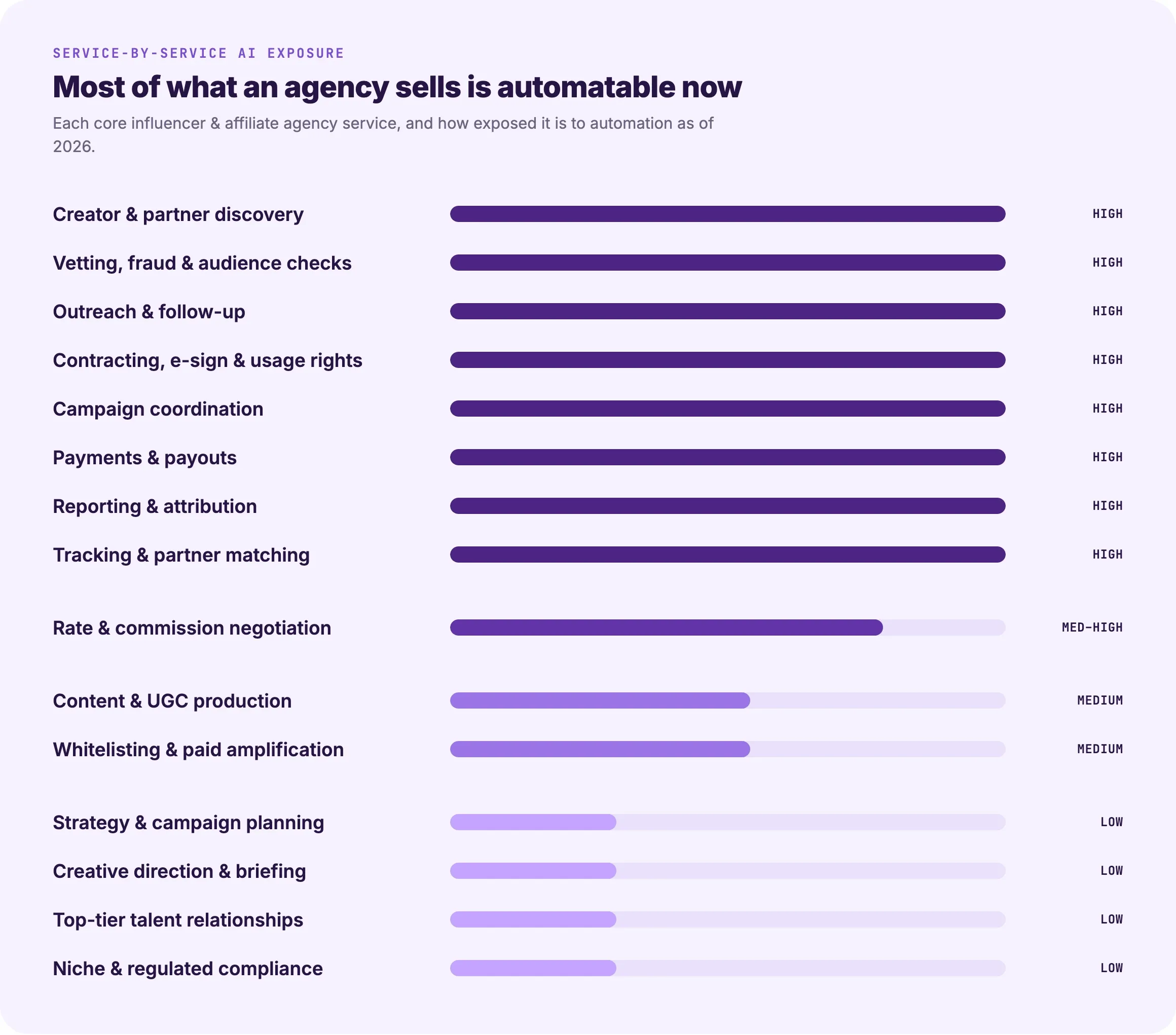
The tools doing this aren’t hypothetical. AI matching across millions of profiles cuts vetting time by an estimated 73% (Influencer Marketing Hub). Agentic outreach scales from 200 to 5,000 monthly touches with no new hires (Janney AI). Contracts template, e-sign, and schedule payment automatically. Automated authenticity scoring and affiliate fraud detection are built into the networks. And multi-touch attribution is replacing last-click across the board — “Ask Impact,” Rakuten’s “Affiliate Intelligence,” and Awin’s AI are all live for tracking and partner matching.
Plenty of these changes are already here. Dentsu’s internal creator-discovery agent has been live since early 2026 and drove a 41% conversion lift on one campaign. (Digiday) GRIN shipped an agentic assistant spanning discovery through reporting across a database in the hundreds of millions. (Scoop) Billion Dollar Boy cut campaign-management time roughly 20x with its own platform. (NetInfluencer) On the affiliate side, Acceleration Partners maintains a proprietary publisher CRM of 60,000+ click-active partnerships and built an in-house AI assistant to speed decisions. (Acceleration Partners)
A note on the efficiency stats: figures like “73% less vetting” and “200 to 5,000 outreaches” come from vendor and platform sources, so treat them as directional rather than audited. The direction, however, is not in dispute.
The three layers hiding inside every agency
Read the chart again and a structure emerges. Agency work stacks into three layers.
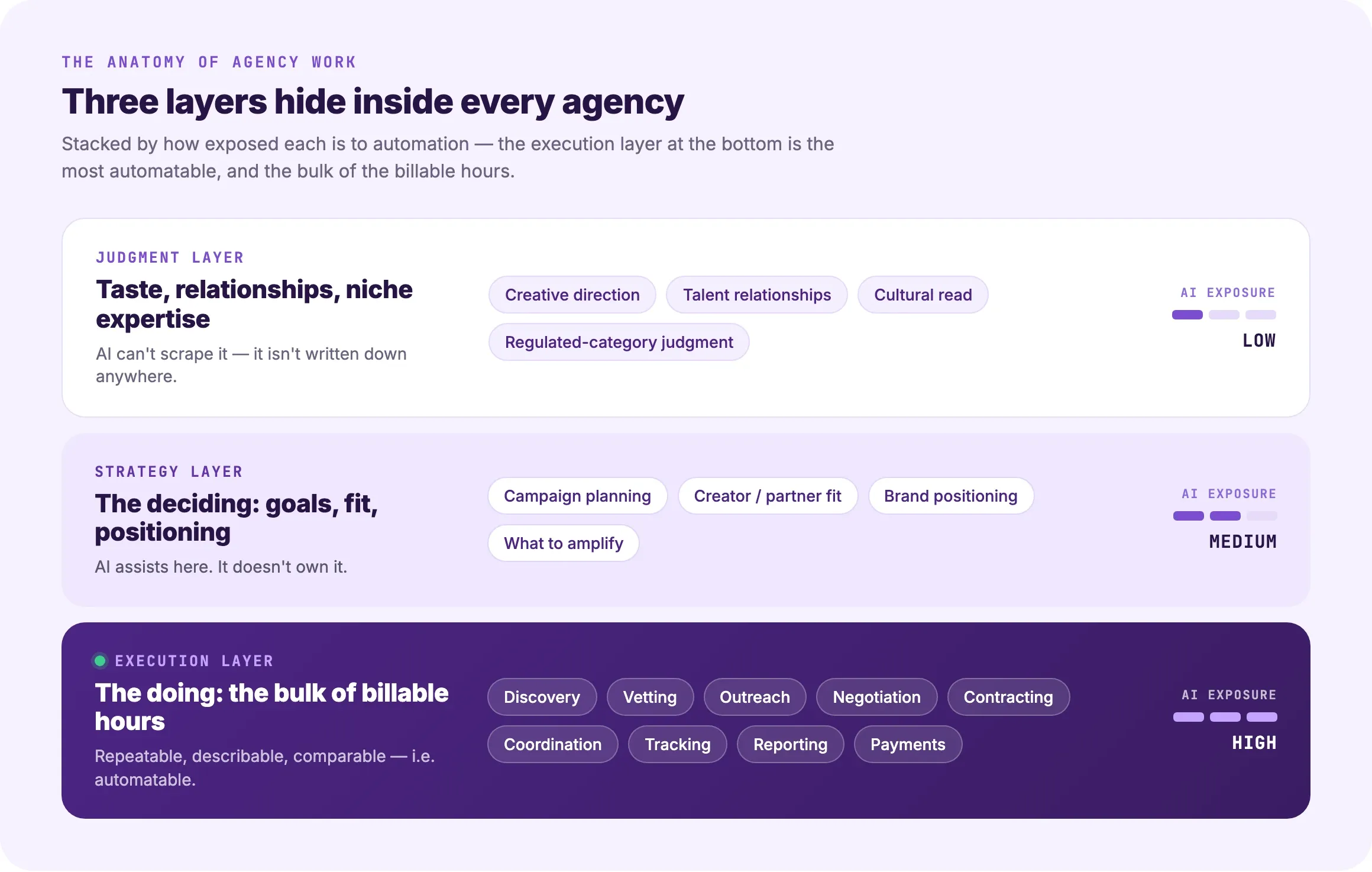
The execution layer is the doing: discovery, outreach, contracting, coordination, posting, tracking, reporting, payments. It is the bulk of the billable hours and the most automatable part of the business.
The strategy layer is the deciding: what the campaign is trying to achieve, which creators or partners actually fit, how to position the brand, what to amplify and when. AI assists here but doesn’t own it.
Above both sits a judgment layer: taste, cultural instinct, relationships with talent that won’t answer a cold DM, and deep vertical knowledge in categories where being wrong is expensive. This is the layer AI can’t scrape, because it isn’t written down anywhere to be scraped. (We’ve written the full framework for what to delegate to agents and what humans should own if you want to go deeper.)
The critical point — and the one most “AI kills agencies” takes miss — is that the execution layer is made of both people and software. It was never purely human. And both halves are being commoditized at the same time.
Why agencies may be safer than the software vendors
When execution commoditizes, the total addressable value of execution services falls. Fees on that work compress, retainers get questioned, and more of it moves in-house. Generalist agencies already show the squeeze: specialists run 20–30% margins while generalist shops sit at 10–15%. (ALM Corp) One analysis put it well — AI is squeezing agencies from both sides, since agencies use it to cut delivery costs while clients use the same tools to question the bill. (Search Engine Land)
But as the execution layer compresses, agencies aren’t the only ones standing in it.
Here’s the part worth sitting with: software is in the execution layer, and software is getting radically cheaper to build. As generative AI lowers the barrier to creating software, Goldman Sachs analysis suggests enterprises “might not have to buy so much software” and will generate more in-house instead. (Monetizely) A single person with AI assistance can now build what once required a team. (a16z)
So maybe the execution layer is commoditized by 50%. But will that be split evenly across software and agencies? Probably not.
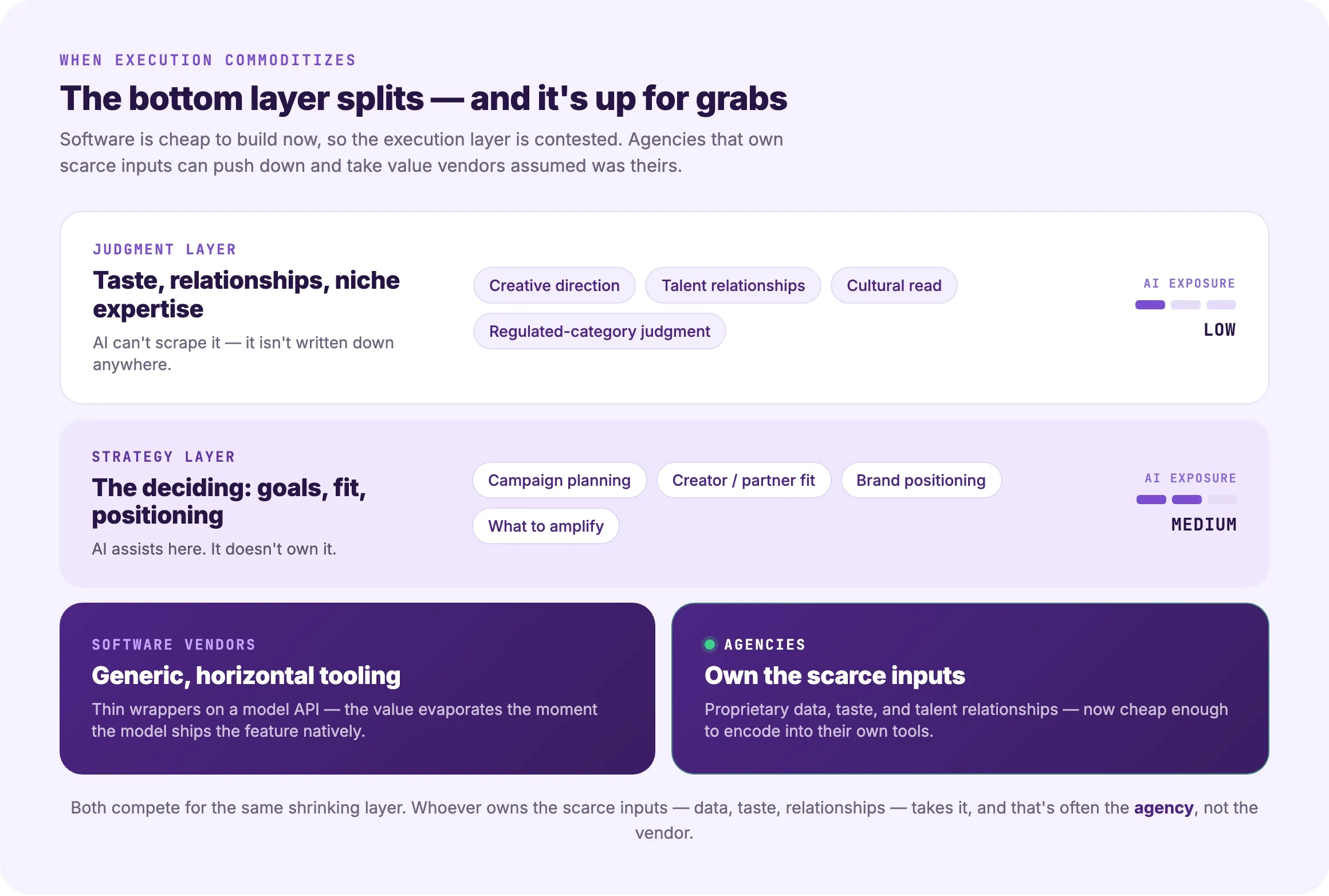
An agency with genuine niche knowledge — the beauty shop that spots a creator eighteen months early, the affiliate agency with a hand-tagged database of 60,000 vetted partners — can now encode that knowledge into its own workflows and tools cheaply enough to capture the execution value itself, rather than renting a generic platform. They may be very well positioned to capture more of the execution layer. Acceleration Partners (APVision), Billion Dollar Boy (Companion), and Dentsu (its discovery agent) are early proof that agencies are building, not just buying.
The group with the weaker hand is the generic software vendor. Venture investors have largely stopped funding “thin wrappers” — products that put a UI on a model API with no real differentiation — because “when the underlying model provider ships the same feature natively, the wrapper’s value proposition evaporates overnight.” (AI Magicx) The defensible moats in 2026 are proprietary data, embedded workflow, and domain expertise (SaaS Mag) — which is exactly the list an agency with a real niche already owns and a horizontal tool vendor does not. Gartner expects half of agencies’ proprietary AI platforms to be obsolete by 2029 as hyperscaler tooling undercuts them (Marketing Dive); the same logic is far more brutal for a software company whose entire business is one commoditizing layer.
If execution is won by whoever owns taste, data, and relationships, the agency is often holding better cards than the vendor.
Which agencies are in trouble, and who’s poised for massive growth
In trouble: the undifferentiated middle. Generalist “we do everything” agencies that package replaceable tasks and price by the hour or the headcount are the most exposed — their services are the easiest to prompt and the easiest to compare, which is precisely what makes clients bring the work in-house or automate it. (Search Engine Land) Also exposed: point-solution software vendors whose only value was a feature a foundation model can now replicate.
Poised to grow: agencies that own something scarce. Deep vertical specialists — beauty, gaming, and regulated categories like healthcare, fintech, and finance — command premium fees because context and judgment still matter and don’t reduce to a prompt. (ALM Corp) So do agencies with proprietary data and hard-won talent relationships, taste-led creative shops, those shifting to outcome and performance-based pricing, and — critically — the ones building their own tools off their niche knowledge so they can win the execution layer instead of surrendering it. These agencies need fewer people, but each person, armed with proprietary systems, is dramatically more productive.
The affiliate corner deserves its own note, because it faces a second force: AI shopping agents and AI-generated search answers do exactly what affiliate publishers do — compare, recommend, hunt deals — which threatens last-click attribution as traffic gets intercepted inside the chatbot. (eMarketer) The affiliate agencies that adapt — moving to multi-touch attribution, generative-engine optimization, and long-term creator partnerships — can turn that threat into an advantage, since affiliate’s pay-per-sale rails are a natural fit for agentic commerce.
The bottom line
The influencer and affiliate agency that sells execution — hours, coordination, and undifferentiated tasks — is dying, and AI is the cause. That’s the death in the headline, and I think that market shrinking quickly is a safe bet.
But the agency defined by its judgment layer — taste, relationships, and niche knowledge — isn’t just surviving. Because software is now cheap to build, that agency can push down into the execution layer it used to rent, and take value that generic vendors assumed was theirs. The scarce inputs win, and agencies with a real niche own the scarce inputs.
The influencer agency is dead. Long live the influencer agency.
Turn creators into your top revenue channel.
Agents, storefronts, and performance programs in one platform — in production for the world's most forward DTC brands.
More from the blog.
All posts → Strategy
How brands can leverage UGC to win AI Search (GEO).
AI Search (GEO) is big business, and the key to winning is a new UGC / Creator Content strategy
Read more → Strategy
The agentic future of influencer marketing: what humans own
Agentic influencer marketing is here. A framework for what to delegate to AI agents — and what to keep in human hands.
Read more → Strategy
Social Shopping: The Future of E-commerce Is Here
The line between social media and e-commerce has blurred into social shopping, where consumers discover, research, and buy in one place.
Read more →